
Ring Superbowl Ad
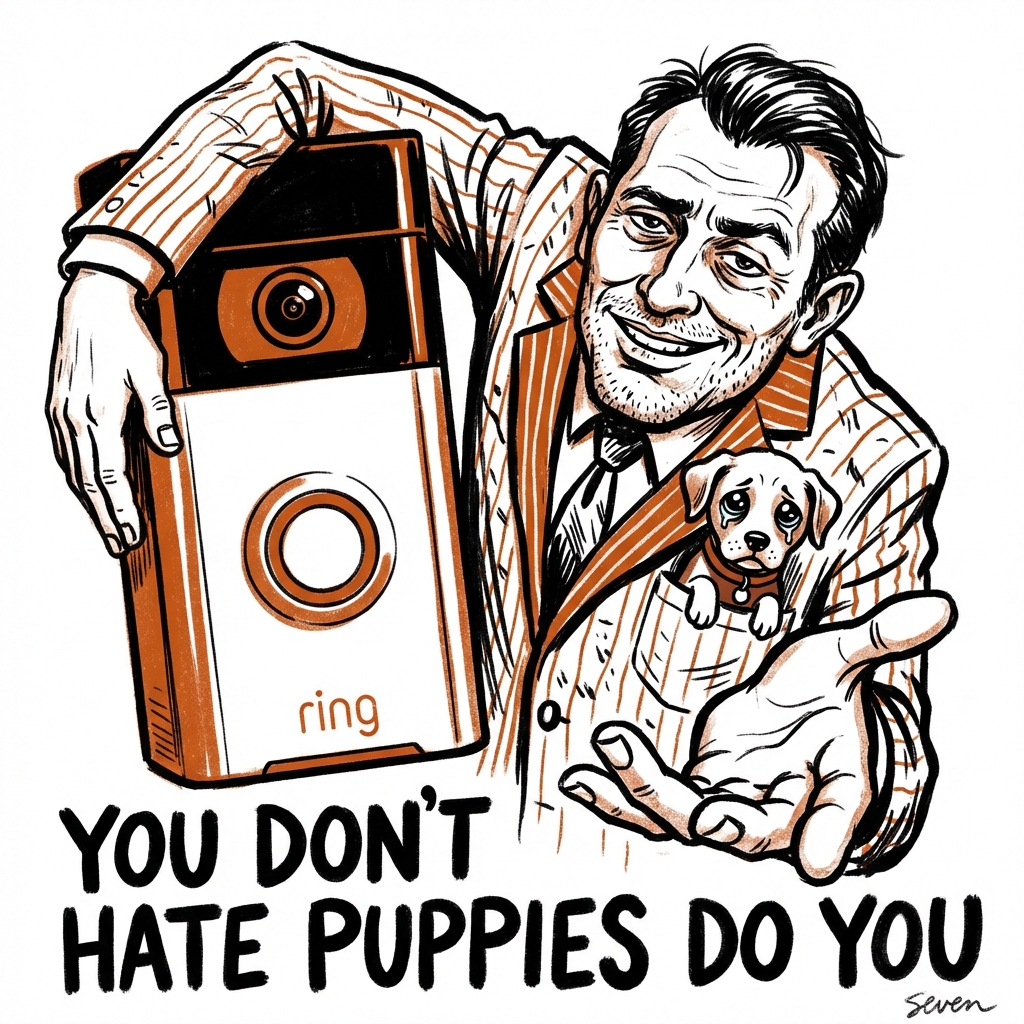
Ring paid big money to convince you their "search party" feature is a communal good. Don't be fooled into believing them.
NEWSOPINION
2/10/20264 min read
You're Paying Ring to Watch Your Neighbors (And They're Paying to Watch You)
Ring aired its first-ever Super Bowl ad this year, and it was exactly what you'd expect from a company trying to make mass surveillance feel warm and fuzzy: lost puppies.
The ad promoted Ring's "Search Party" feature, which turns every outdoor Ring camera in a neighborhood into a connected AI surveillance network. The pitch? Help find lost dogs. Your camera spots a pup that matches a missing pet report, and the owner gets notified. Everyone eats an apple pie and lives happily ever after.
If you stop for a moment and think about it though, you can see the darker image begin to form. The technology that identifies a dog walking past your porch is the same technology that identifies a person walking past your porch. And Ring already knows that.
It's Not About the Dogs
Just a few months before this Super Bowl ad, Ring quietly rolled out a separate feature called "Familiar Faces." It uses AI-powered facial recognition to identify and catalog up to 50 people who approach your Ring doorbell. Family, friends, delivery drivers, the neighbor kid selling popcorn for scouts. All scanned, all cataloged, all stored.
So Ring already has the infrastructure scanning people. The Super Bowl ad just gave millions of viewers a reason to feel good about it.
This is a pattern we've seen before in tech. Introduce a capability through an emotional, hard-to-argue-with use case. Lost pets. Missing children. Package theft. Then, once the infrastructure is in place and everyone's opted in (or more accurately, forgotten to opt out), expand the scope.
Does anyone seriously believe a company owned by Amazon built a neighborhood-wide AI surveillance network... for dogs?
You either Fido, or you Fidon't
The worst part about this is that search Party is enabled by default on every outdoor Ring camera. You don't choose to join this network. You're placed in it. Your camera starts scanning the neighborhood the moment the feature goes live, and it's on you to dig through settings to turn it off.
That means if your neighbor has a Ring camera pointed at the sidewalk, you're being scanned whether you bought a Ring or not. Whether you agreed to it or not. Whether you even know about it or not.
And for the people who did buy a Ring camera? You paid for the hardware. You pay a monthly subscription for cloud storage. And in return, Ring uses your camera, your electricity, and your internet connection to build a surveillance network that benefits Amazon.
You're not the customer. You're the infrastructure.
A Quick History Lesson
This is the same company that paid a $5.8 million FTC fine in 2023 because their employees had "broad and unrestricted access" to customers' private video footage.
The same company that has active partnerships with police departments across the country, creating pathways for law enforcement to access footage, sometimes without a warrant.
The same company whose "Familiar Faces" feature is so problematic that it can't even launch in Illinois, Texas, or Portland because it violates their biometric privacy laws.
This isn't a company that has earned the benefit of the doubt on privacy.
Put on your critical thinking hat
You wouldn't pay someone to stand on your street corner with a clipboard, writing down who comes and goes from your house, what time your kids leave for school, and when you're not home. You'd call that creepy and you might call the police.
But mount a camera on the doorbell and connect it to Amazon's cloud, and suddenly it's a "smart home upgrade."
The product is convenience. The cost is your neighborhood's privacy. And the real customer isn't you. It's every entity willing to pay Amazon for access to that data, whether that's advertisers, law enforcement, or whatever comes next.
What You Can Do
I'm not here to tell you to rip your Ring off the wall (though you may want to consider it). But I do think it's worth considering what you're actually buying when you buy one of these devices.
If you already own a Ring camera:
- Open the Ring app, go to Control Center, and disable Search Party. It's on by default. Turn it off for every camera.
- While you're there, check whether Familiar Faces is enabled and decide if you're comfortable with that (are YOU benefiting from it in any tangible way?)
- Understand that Ring's cloud storage means Amazon has access to your footage. ALL OF IT.
If you're thinking about buying one, ask yourself: do you want a security camera, or do you want to fund a corporate surveillance network that happens to also show you who's at your door?
There are cameras that store footage locally, don't require subscriptions, and don't phone home to Amazon. They just don't have Super Bowl ads with puppies.
Bottom Line
Ring used the most-watched broadcast of the year to convince 125 million people that neighborhood-wide AI surveillance is a feel-good community feature. They led with lost dogs because lost dogs are hard to argue with.
But the infrastructure doesn't care whether it's scanning for a golden retriever or your next-door neighbor. And if you think this technology is going to stay limited to finding pets, I have a Ring doorbell to sell you.
Don't pay someone else to take your privacy. And definitely don't pay them to take your neighbor's.
Privacy Made Simple
Simple tips for protecting your online privacy.
© 2025. All rights reserved.